- Compressor that operates with an intake pressure below atmospheric and discharge pressure usually atmospheric or slightly high.
A vacuum pump is designed to create a partial or low-pressure vacuum by removing gas or air molecules from a sealed chamber. The term “vacuum” refers to a relative pressure state where the chamber pressure is lower than the surrounding atmosphere or adjacent systems. This contrasts with an absolute vacuum, where the pressure is 0 Pa (Pascal) and the chamber is devoid of gas molecules.
One of the key elements in the operation of a vacuum pump is atmospheric pressure, which is the weight of the air pressing down on the Earth. This pressure is generated by the weight of air molecules and decreases as altitude increases. Atmospheric pressure significantly impacts the operation of machines, particularly vacuum pumps. This pressure tries to equalize by moving molecules from areas of higher pressure to areas of lower pressure, driven by the principle of pushing molecules to fill a vacuum or low-pressure space.
The purpose of all pumps is to convert energy into pressure. The amount of energy required to operate a pump varies with atmospheric pressure. Higher atmospheric pressure generally enhances the efficiency of a vacuum pump’s operation. Since atmospheric pressure is crucial to the performance of a vacuum pump, it significantly affects operational costs and can fluctuate based on factors such as temperature, humidity, and altitude.
Vacuum pumps remove air molecules (and other gases) from the vacuum chamber (or the outlet side in the case of a higher vacuum pump connected in series). As the pressure in the chamber is reduced, removing additional molecules becomes increasingly harder to remove. Therefore, an industrial vacuum system must be able to operate over a portion of an extraordinarily large pressure range, typically varying from 1 to 10-6 Torr / 1.3 to 13.3 mBar of pressure. In research and scientific applications this is extended to 10-9 Torr or lower. To accomplish this, different types of pumps are used in a standard vacuum system, each covering a proportion of the pressure range, and operating in series at times.
Different degrees of vacuum can be achieved, ranging from low vacuums with absolute pressures between 1 and 0.03 bars, to high vacuums that can reach pressures as low as a billionth of a Pascal. Low and medium vacuums are frequently used in industrial applications including vacuum grippers, vacuum cleaners, incandescent bulbs, painting, sandblasting, vacuum furnaces, and negative pressure ventilation. In contrast, higher vacuum systems are essential for specialized laboratory applications such as particle accelerators and reactors.
Types of Vacuum pumps:
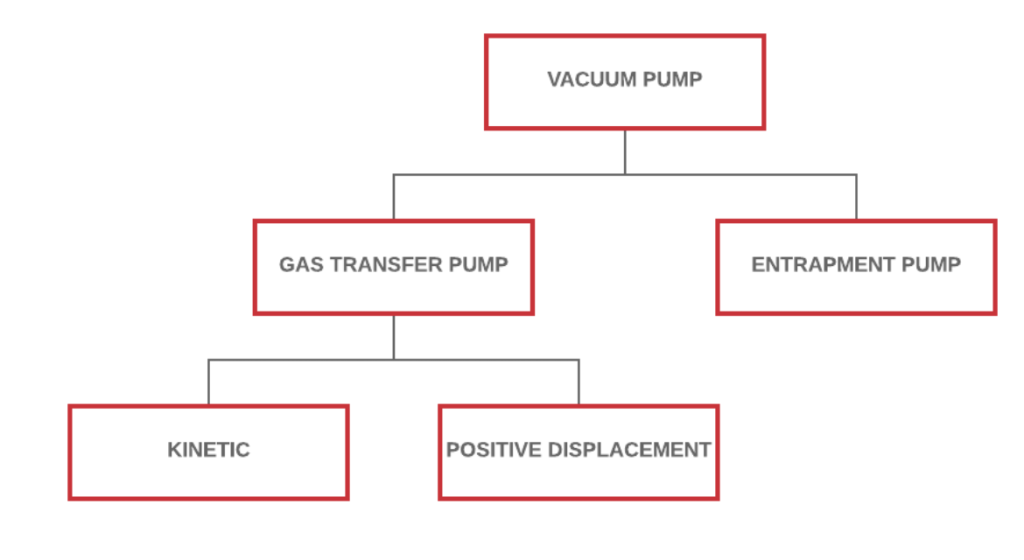
- Gas Transfer Pumps
Transfer Pumps transfer gas molecules by either momentum exchange (kinetic action) or positive displacement. The same number of gas molecules are discharged from the pump as enter it and the gas is slightly above atmospheric pressure when expelled. The compression ratio is the ratio of the exhaust pressure (outlet) to the lowest pressure obtained (inlet).
- Kinetic Transfer Pumps
Kinetic transfer pumps use high speed blades or introduced vapor to direct gas towards the outlet, working on the principle of momentum transfer. These types of pump can achieve high compression ratios at low pressures but typically don’t have sealed volumes.
- Positive Displacement
Pumps which work by mechanically trapping a volume of gas and moving it through the pump are known as positive displacement pumps. Often designed in multiple stages on a single drive shaft, the isolated volume is compressed to a smaller volume at a higher pressure, and finally the compressed gas is expelled to either atmosphere or the next pump. To provide a higher vacuum and flow rate two transfer pumps are often used in series.
As mentioned previously, positive displacement vacuum pumps are used to create low vacuums. This type of vacuum pump expands a cavity and allows the gases to flow out of the sealed environment or chamber. After that, the cavity is sealed and causes it to exhaust it to the atmosphere. The principle behind positive displacement vacuum pump is create a vacuum by expanding the volume of a container. For example, in a manual water pump, a mechanism expands a small sealed cavity to create a deep vacuum. Because of the pressure, some fluid from the chamber is pushed into the pump’s small cavity. After that, the pump’s cavity is then sealed from the chamber, opened to the atmosphere and then squeezed back to a minute size. Another example of positive displacement vacuum pumps is like a diaphragm muscle expands the chest cavity, causing the volume of lungs to increase. This expansion results to creating a partial vacuum and reducing the pressure, which is then filled by air pushed in by atmospheric pressure. The examples of positive displacement vacuum pumps are liquid ring vacuum pumps and roots blower which are highly used in various industries to create vacuum in confined space.
- Entrapment Pumps
Pumps which capture gas molecules on surfaces within the vacuum system are unsurprisingly known as, Capture or Entrapment Pumps. These pumps operate at lower flow rates than vacuum pumps such as transfer pumps, however, they can provide extremely high vacuum, down to 10-12Torr. Capture pumps operate using cryogenic condensation, ionic reaction, or chemical reaction and have no moving parts, therefore creating oil-free vacuum.
Those Entrapment Pumps that work using chemical reactions, perform more effectively as they are usually placed inside the container where vacuum is required. Air molecules create a thin film which is removed as the pumps operation cause a chemical reaction to the internal surfaces of the pump. Entrapment pumps are used along with positive displacement vacuum pumps and momentum transfer vacuum pumps to create ultra-high vacuum.
Wet and Dry Vacuum Pumps:
Vacuum pump technologies are considered either wet (lubricated) or dry (oil free or dry running), depending on whether or not the gas is exposed to oil or water during the compression process.
Wet pumps lubricate and/or sealing themselves using either oil or water; this fluid can contaminate the pumped (swept) gas. Whereas Dry vacuum pumps have no fluid in the pumped gas, relying on precise clearances between the rotating and static parts of the pump, dry polymer (PTFE) seals, or a diaphragm to separate the pumping mechanism from the gas and ensure a tight seal.
However, dry are not completely oil-free, as oil or grease is often used in the pump gears and bearings. This is kept separate from the vacuum compression side. Dry pumps reduce the risk of contamination and oil mist. They also have environmental benefits of not requiring the disposal of oils like lubricated pumps.
Pressure Ranges of Industrial Vacuum System
Industrial Vacuum systems can be placed into the following groups of pressure ranges: