An extra or unwanted airflow breaking through a pressurised vessel, pipe, or joint is called compressed air leakage. Generally, air leakage happens from inside out – a flow of air from high pressure to low pressure – but may also occur from outside when ambient air flows into a vacuum vessel.
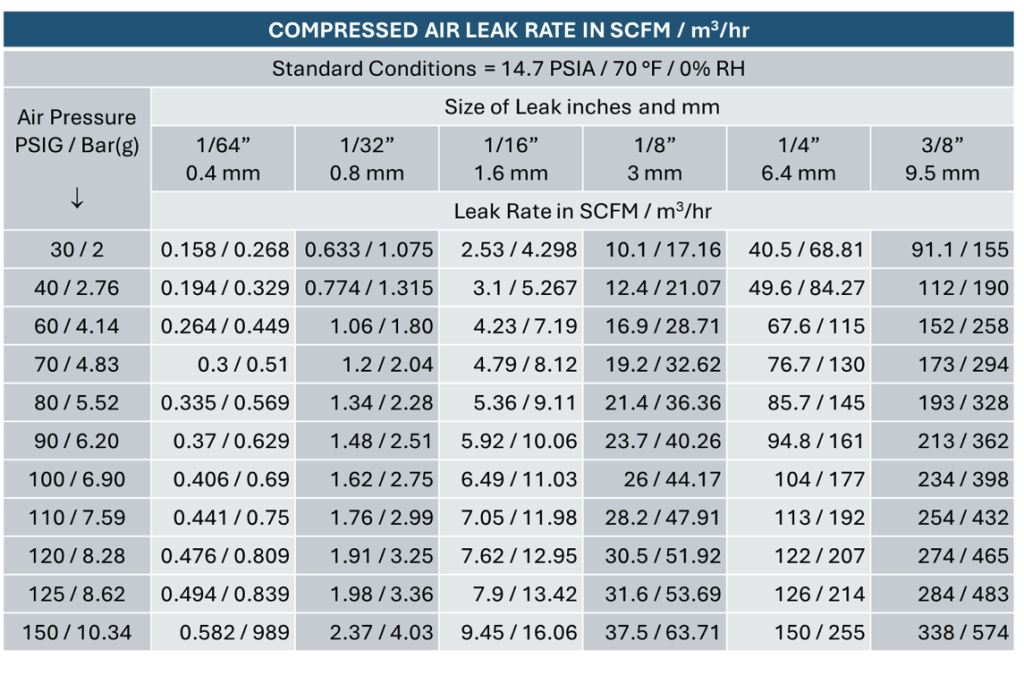
The amount of leak through an orifice or opening depends on the size of the orifice and the air pressure. Higher the air pressure, higher is the amount of air leaking through the same size of an orifice. In real industrial installations the air leaks through variety of randomly shaped orifices or holes. Their shape also affects the size of the leak, and the value of ultrasonic signal generated by the leak.
Following table from CAGI shows the air leakages at various pressures and round orifice sizes (values should be multiplied by 0.97 for well-rounded orifices and by 0.61 for sharp orifices):
Statistically, in about 30% of the cases the leaks are loud, unpleasant and audible hissing. In remaining cases, the leaks emitting sounds are inaudible to the human ear, because they have a frequency of 30-44 kHz (ultrasound). Such leaks need to be detected by using ultrasonic leak detectors.
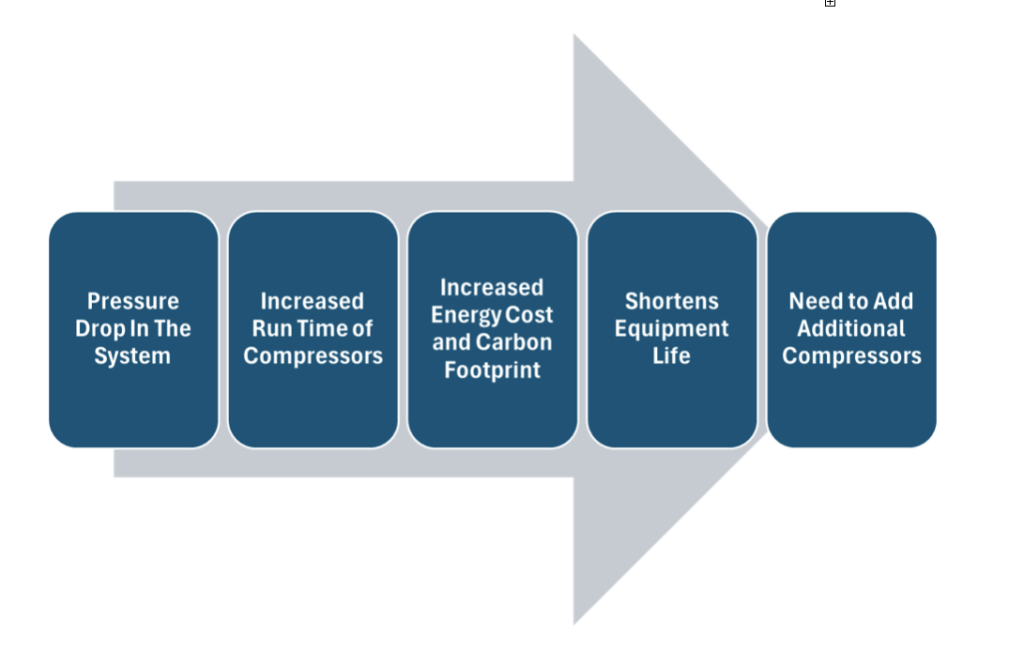
Effects of Compressed air leakages:
(See also, ‘Leak detectors’)