(as defined in 2016 Building Energy Efficiency Standards – Reference Ace v31) – is the largest increase in capacity when switching between combinations of base compressors that is expected to occur under the compressed air system control scheme.
This term pertains to deciding capacity of Trim Compressor(s) and Storage.
Trim compressor can be with Option-1 (VSD compressor), and Option-2 (Fixed speed compressor).
The compressed air system must be equipped with an appropriately sized trim compressor(s) and primary storage to provide acceptable performance across the range of the system and to avoid control gaps. The trim compressor(s) and primary storage must comply with one of two options below:
• Option 1 includes one or more variable speed drive (VSD) compressors. Systems using VSD compressors must meet the following:
- For systems with more than one compressor, the total combined capacity of the VSD compressor(s) acting as trim compressors must be at least 1.25 times the largest net capacity increment between combinations of compressors.
- The compressed air system must include primary storage of at least one gallon per actual cubic feet per minute (acfm) of the largest trim compressor.
• Option 2 does not require a VSD compressor:
- The compressed air system must include a compressor or set of compressors with a total effective trim capacity no less than the largest net capacity increment between combinations of compressors, or the size of the smallest compressor, whichever is larger.
- The total effective trim capacity of single compressor systems must cover at least the range from 70 to 100 percent of the rated capacity. The effective trim capacity is the size of the continuous operational range where the specific power of the compressor (kW/100 acfm) is within 15 percent of the specific power at its most efficient operating point. The total effective trim capacity of the system is the sum of the effective trim capacity of the trim compressors.
- The system must include primary storage of at least 2 gallons per acfm of the largest trim compressor.
Example: Given a system with three base compressors with capacities of 200 acfm (Compressor A), 400 acfm (Compressor B) and 1,000 acfm (Compressor C), the Largest Net Capacity Increment is shown in below diagram.
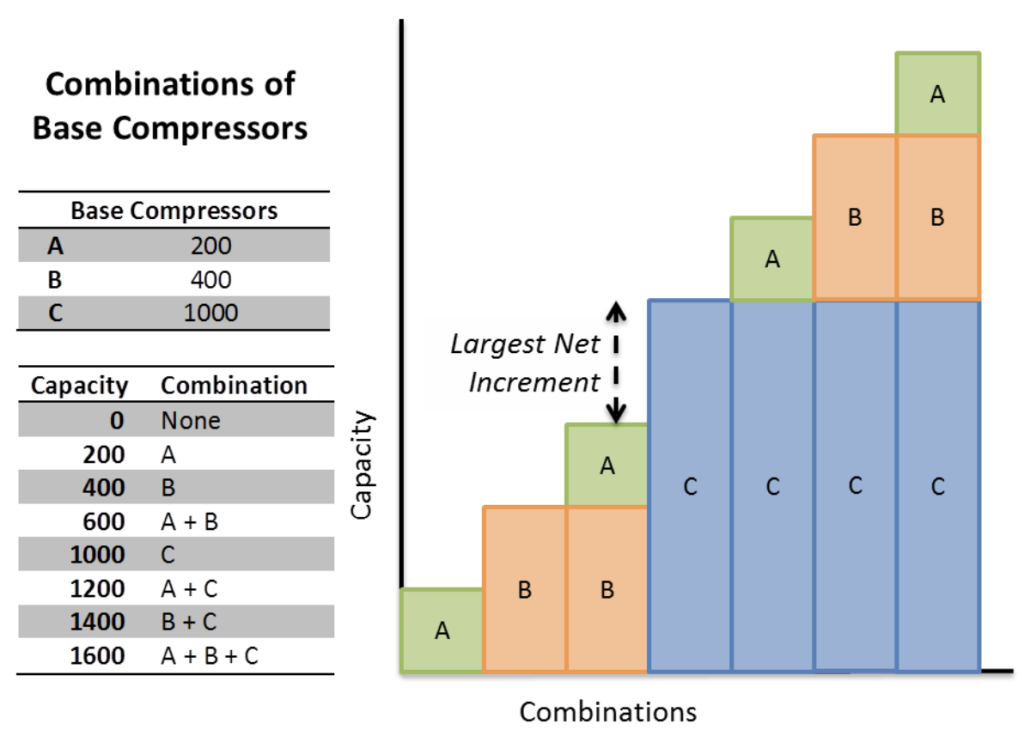
As shown in the image above, there are 8 possible stages of capacity ranging from 0 acfm with no compressors to 1,600 acfm with all three compressors operating. The largest net increment is between stage 4 with compressors A and B operating (200+400=600 acfm) to stage 5 with compressor C operating (1,000 acfm).
For this system the Largest Net Capacity Increment is 1,000 acfm-600 acfm = 400 acfm.